
Which Real Estate Valuation Method Is Right for You?
A Quick Comparison of Appraisals, CMAs, and AVMs

Hi, I’m David Ziccardi. Join my newsletter for straightforward advice and clarity to help you navigate the complexities of residential real estate with confidence.
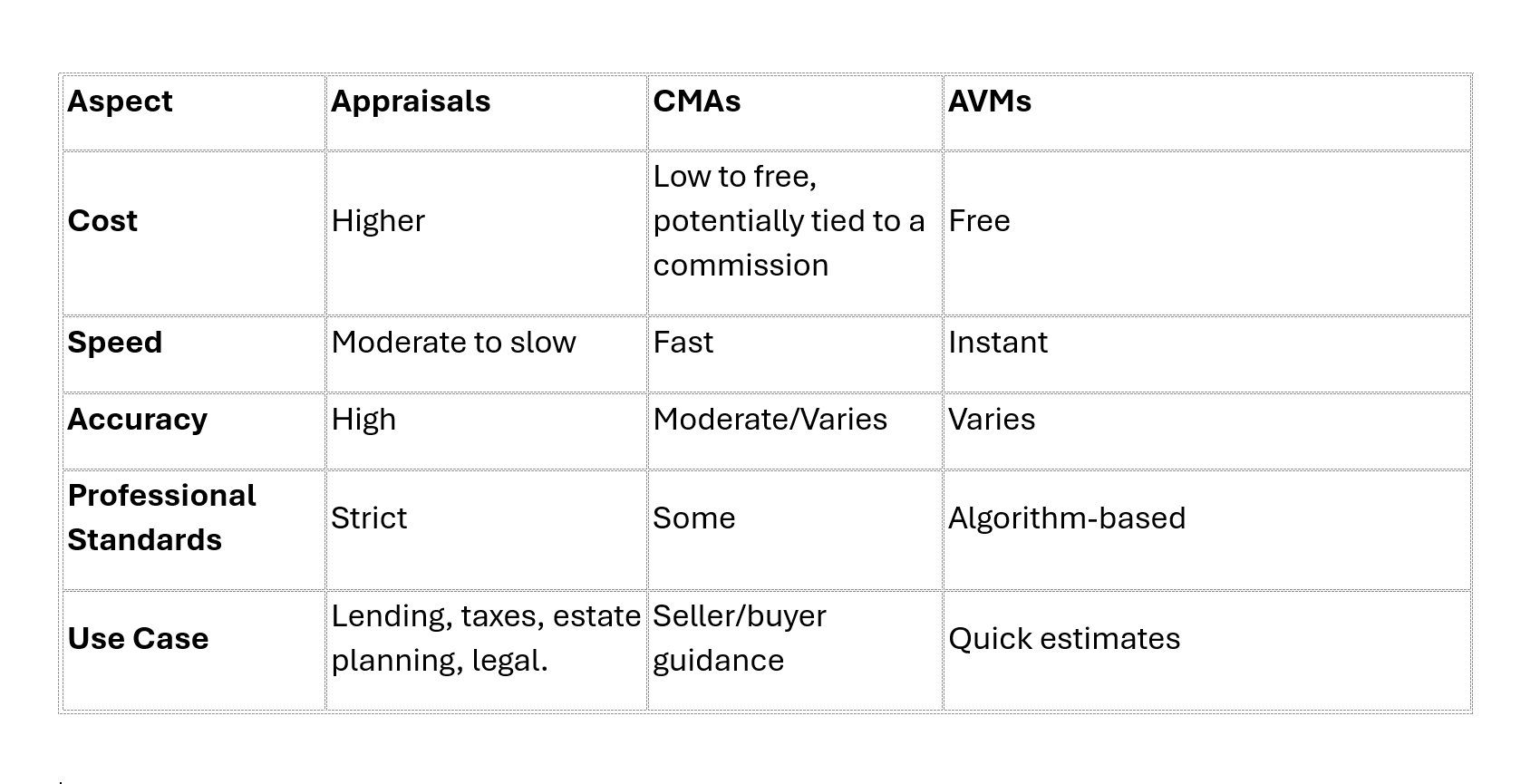
When evaluating real estate appraisals, agent's comparative market analyses (CMAs), and automated valuation models (AVMs) like Zillow, it's essential to understand their unique strengths and limitations. Each serves a purpose in the real estate market, and their utility depends on the context and user needs.
1. Appraisals
Definition: A formal, professional valuation conducted by a state credentialed appraiser.
Strengths:
Conflict-Free: Appraisers are typically paid a flat fee for their service, rather than a commission tied to the property value or sale, ensuring there’s no incentive to inflate or undervalue the property.
Audit Trail: The detailed methodology and supporting data in an appraisal make it more defensible against legal challenges, unlike less formal valuation methods.
Complex Properties/Markets: Appraisals excel in valuing unique, high-value, complex properties, or highly specialized markets where data may be scarce or inconsistent and where valuation tools like AVMs or CMAs struggle.
In-depth analysis of the subject property, competitive market segment, and market area/conditions.
Typically, but not always, includes an on-site observation of the subject property
Governed by stringent standards: USPAP (Uniform Standards of Professional Appraisal Practice) = standardized quality (for the most part).
Limitations:
Higher cost than comparable valuation methods
Time-consuming, often taking several days or weeks.
Static report
2. Comparative Market Analyses (CMAs)
Definition: A report prepared by a real estate agent to estimate a property’s market value based on recent sales of similar properties.
Strengths:
Free or low-cost when provided by an agent as part of their services.
CMAs are designed to be straightforward, helping clients easily understand pricing recommendations without extensive technical knowledge.
Dynamic Updates: Agents can easily update CMAs as new listings, sales, or market conditions emerge.
Limitations:
Not as comprehensive as an appraisal.
Quality depends on the agent's expertise and data access.
Potential bias, agent is typically trying to secure representation and CMA may not reflect actual market value.
3. Automated Valuation Models (AVMs)
Definition: Computer-generated estimates of property value based on algorithms and publicly available data.
Examples: Zillow's Zestimate, Redfin Estimate.
Strengths:
Accessible online at any time, often for free.
Instant results.
Widely accessible and easy to use.
Limitations:
Limited accuracy, especially for unique properties or when there is insufficient market data.
AVMs cannot account for property condition, upgrades, or damage, which can significantly affect value.
Lack of subjective inputs like property condition or local market nuances.
Takeaways
Appraisals are unbiased and objective, professionally supported conclusions that serve a variety of purposes.
CMAs are typically for real estate transactions, offering context-sensitive guidance for buyers and sellers.
AVMs provide rapid valuations but should be supplemented with human insights for critical decisions.
For high-stakes decisions, appraisals remain the gold standard, but for everyday needs, CMAs or AVMs may suffice. Obviously, the choice depends on the purpose, budget, and time constraints. If you’re preparing to buy, sell, or invest in real estate, start by determining which valuation method aligns with your goals.
Need a formal appraisal? Contact Valiant Appraisal Services today to get expert advice and ensure you’re making the most informed decision possible. Let’s make your real estate journey a success!